Pages

Thursday, September 30, 2010

RAW BANANA PODIMAS (VAZHAKKAI PODIMAS)


Kerala is famous for its Plantain trees & Coconut palms. Each house will have at least a couple of these trees in their backyard. Kerala is famous for its special variety - Nendran Vazhai. But this recipe is made with the other variety ( ponthan kai)which is available in Tamil nadu.


Preparation Time: 10 mts Cooking Time: 20 mts Serves: 2


Ingredients:


Raw banana - 3 nos
Green chilies - 2 nos
Lemon - 1 no
Mustard seeds - 1/2 tsp
Black gram dal (ulundu paruppu) - 1/2 tsp
Asafoetida powder - 1/2 tsp
Refined oil - 2 tsp
Salt - to taste


Method:


Cut the bananas in to two. Keep it in a bowl of water & boil till it is soft. Allow it to cool down & grate it using a grater. Chop the chilies in to small pieces. Heat oil in a pan & fry the mustard seeds. Add the black gram dal & asafoetida powder & fry well. Then add the cut green chilies & fry for sometime. Add the grated banana. Sprinkle the salt & stir it well. Squeeze the lemon on top & mix well . Vazhakkai podimas is ready.


Variations:


We can add coconut scrapings to the podimas. If coconut is used, then lemon juice is not needed. We can also fry a sliced onion before adding the grated banana. Again lemon juice can be omitted in this.


Tips:


  1. The bananas should be cooked to the right consistency. The moment it starts to get soft, remove it from the heat & allow it to cool. This way, the gratings will come out nicely. If it gets overcooked, then the banana will become mushy while grating.
  2. Add the salt while boiling the bananas. This way the salt will spread evenly.
  3. We can also add the salt to the grated banana, mix it well & prepare the dish.

Taste it & enjoy.

Tuesday, September 28, 2010

PUDALANGAI KOOTU (SNAKE GOURD KOOTU)


Pudalangai is a versatile vegetable which can be cooked in many ways.


Preparation Time: 10 mts Cooking Time: 30 mts Serves: 2


Ingredients:


Pudalangai - 250 gms
Bengal gram dal (kadalai paruppu) - 1 tbsp
Turmeric powder - 1/4 tsp
Mustard seeds - 1/2 tsp
Black gram dal (ulundu paruppu) - 1/2 tsp
Asafoetida powder - 1/4 tsp
Curry leaves - 1 tsp
Refined oil - 1 tbsp


To grind:


Coconut scrapings - 1/2 cup
Green chilies - 3 nos
Cumin seeds (jeera) - 1/2 tsp


Method:


Grind the coconut & other ingredients to a smooth paste. Soak the kadalai paruppu in a little water. Cut the pudalangai in to small pieces. Put the chopped pudalangai & the soaked dal in a pan. Add enough water, turmeric powder & salt. Cook it on low heat till it gets cooked. Add the ground paste & mix well. Let it simmer for sometime till the raw smell goes off. Heat oil in a pan & fry the mustard seeds. Add the urud dal & fry till it becomes brown in colour & add the asafoetida powder & curry leaves. Pour it on top of the pudalangai & mix it well. Pudalangai kootu is ready. This kootu will be good with sambar & rasam as a side dish.


Variations:


This kootu can be made with pumpkin, chow-chow, cabbage, broad beans, string beans etc. We can use red chilies instead of green chilies.


Tips:


  1. While boiling the pudalangai, add just enough water to soak the vegetable. This kootu is thick in consistency because it is a side dish.
  2. Heap the kadalai paruppu in the center & cover it with the pudalangai & boil it.
  3. If the kootu becomes watery, add a little rice flour to thicken it.


Taste it & enjoy.

Monday, September 27, 2010

SNAKE GOURD FRY (PUDALANGAI PORIAL)


Snake gourd is a tropical creeper which is grown all over India. There are two varieties of snake gourd - long & short ones. It is full of fiber & water content is also high. It also has iron, calcium & carotene. Snake gourd is called as Pudalangai in Tamil & Pudavalangai in Malayalam.


Preparation Time: 10 mts Cooking Time: 10 mts Serves: 2


Ingredients:


Pudalangai - 250 gms
Green gram dal (pasi paruppu ) - 1 tsp
Mustard seeds - 1/2 tsp
Red chilies - 2 nos
Refined oil - 1 tsp
Salt - to taste


Method:


Soak the pasi paruppu in little water. Cut the pudalangai in to half lengthwise & cut in to thin slices. Heat the oil in a frying pan & add the mustard seeds. When it is fried, add the red chilies & fry for sometime. Add the chopped pudalangai. Drain the water from the dal & add it to the pudalagai. Sprinkle enough salt, close the pan & cook it on low fire till the pudalangai is cooked. Mix it all together & pudalangai porial is ready.


Variations:


Instead of pasi paruppu, we can add coconut scrapings & make it. Pudalangai can be made plain without either pasi paruppu or coconut. We can also make it with just salt & pepper powder. For this we have to fry the mustard in ghee instead of oil.


Tips:


  1. Don't add water to boil it, because pudalangai will give out water when salt is added to it.
  2. Make a well in the centre & add the pasi paruppu & cover it with the pudalangai. This way the dal will get cooked fast.


Taste it & enjoy.

Sunday, September 26, 2010

PAV BHAJI


Pav bhaji is a North Indian dish, which has lot of fans in South India. It is a very easy & tasty dish to make.


Preparation Time: 10 mts Cooking Time: 30 mts Serves: 2


Ingredients:


Pav bun - 2 nos
Potato - 250 gms
Big onions - 1 no
Tomato - 1 no
Cumin seeds (jeera) - 1/4 tsp
Turmeric powder - 1/4 tsp
Chili powder - 1/2 tsp
Dhania powder - 1/2 tsp
Cumin powder - 1/4 tsp
Ginger garlic paste - 1/4 tsp
Pav bhaji masala - 1/2 tsp
Refined oil - 2 tsp
Ghee - 2 tsp
Coriander leaves - 2 tsps
Salt - to taste


Method:


Boil the potatoes, mash it & keep it aside. Slice the onions & chop the tomatoes in to small pieces. Heat oil in a pan & fry the jeera. Add the sliced onions & saute till it is brown in colour. Add the tomato & fry well. When the tomatoes are mashed well, add the ginger garlic paste & fry till the raw smell goes off. Then add the turmeric, chili, coriander & cumin powders & saute well. Then add the mashed potatoes & mix it all well. Add enough water & bring it to a boil. Then add the pav bhaji masala & let it simmer for a few minutes. Garnish with coriander leaves & masala is ready.


To serve:


Heat a tawa. Slice the pav bun in to half & open it up. Put a little ghee in to that & roast it in the tawa. Turn it on the other side & repeat the same step. Let both the sides become a little brown. In a plate, keep the pav bun, little masala, little chopped onions & a small piece of lemon & serve it with a spoon.
Variations:
We can add grated carrots &boiled peas to the potato masala.
Taste it & enjoy.

Sunday, September 19, 2010

SEMIA BAHALBATH (VERMICILLI IN CURD)


Bahalabath generally means curd rice. People normally make curd rice or curd sevai. Here i have made curd semia. It has a special taste & texture. I am sure you will all enjoy it.


Preparation Time: 10 mts Cooking Time: 20 mts Serves: 2


Ingredients:


Semia ( vermicelli ) - 100 gms
Milk - 1 cup
Curd - 1/2 cup
Coriander leaves - 1 tsp (chopped)
Green chilies - 1 no
Refined oil - 1 tsp
Mustard seeds - 1/2 tsp
Salt - to taste


Method:


Boil plenty of water in a pan. When it boils, add the semia & let it boil till it is soft. Remove it from fire & drain in a sieve. Wash it under running water & allow to drain. Let it cool for sometime. Then add salt, milk & curd & mix it all together. Heat oil in a pan & fry the mustard seeds & finely chopped green chilies. Pour it on top if the semia & mix well. Garnish with chopped coriander leaves. Semia bahalabath is ready to eat.


Variations:


The only variation i can think of is substituting semia with rice or rice vermicelli (sevai).


Tips:


  1. While boiling the semia, use plenty of water. Add a little oil in the water. This will make the semia non-sticky.
  2. While making bahalabath always use more milk. It will be better if the milk & curd proportion is 3:1.
  3. Always make sure that the semia cools down well before adding the milk. Otherwise it will absorb a lot of milk.
  4. We can also add fruits like green grapes (seedless), raisins etc. We can fry some cashew nuts to add richness to the taste. We can also add some finely chopped cucumber & carrots to the bahalabath.


Taste it & enjoy.

Thursday, September 16, 2010

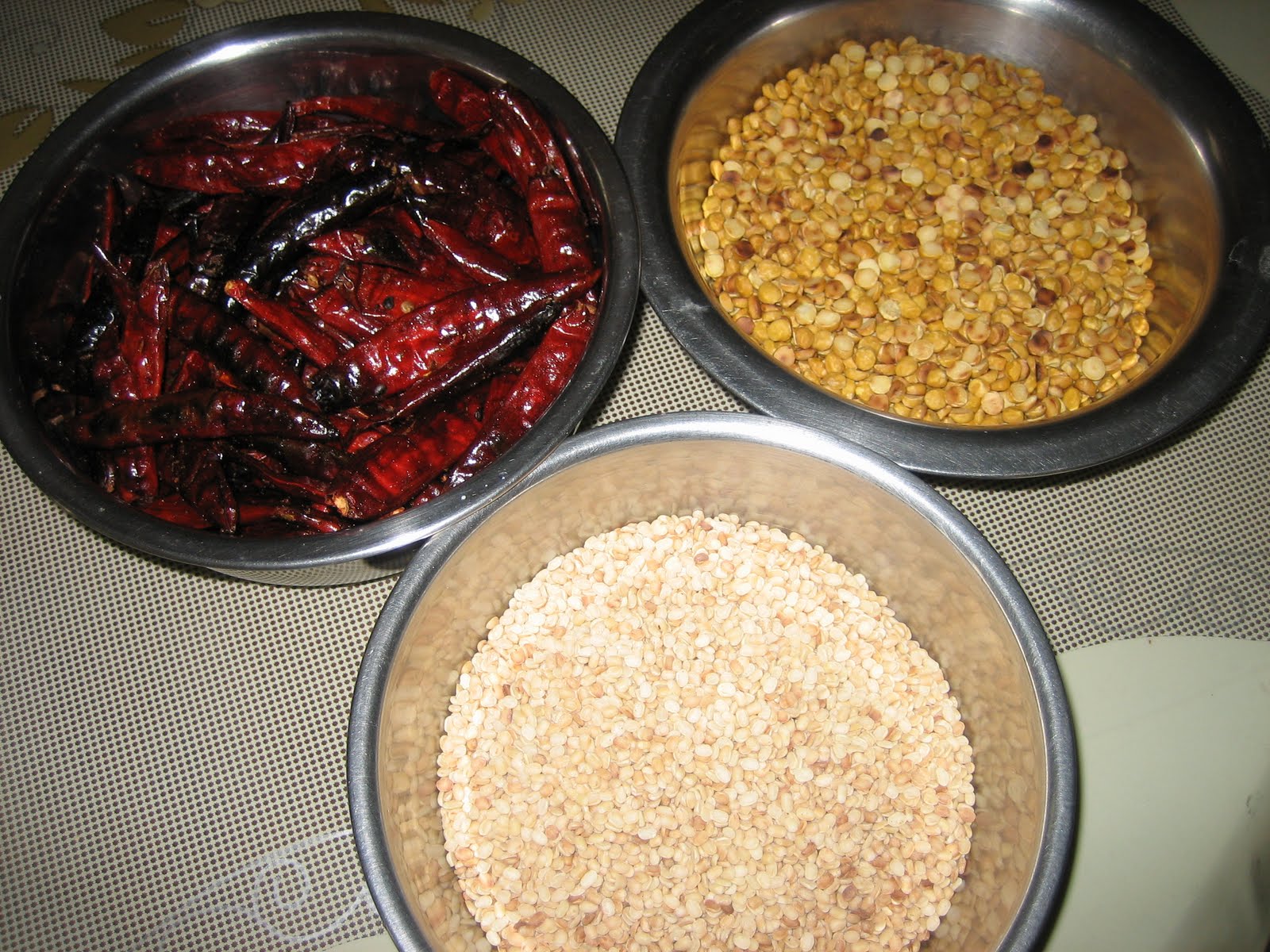
DOSA MILAGAI PODI ( CHUTNEY POWDER )


South India is famous for its breakfast items like idli, dosa etc. These breakfasts are not complete without the milagai podi. This podi comes in handy when we have sudden guests. It is also ideal to carry with us while travelling. Each of the Southern states has its own version of milagai podi. My recipe is from Tamil Nadu.


Preparation Time: 10 mts Cooking Time: 20 mts


Ingredients:


Broken urud dal (black gram dal) - 1 cup
Channa dal (kadalai paruppu/ bengal gram dal) - 1 cup
Dried red chilies - 1 1/2 cups
Refined oil - 1 tsp
Asafoetida powder - 1 tsp
Salt - to taste


Method:


Heat a pan & dry fry the urud dal & channa dal separately, till they are brown in colour. Pour the oil & fry the asafoetida powder. Add the red chilies & fry till it turns brown. Allow it all to cool down. Then powder it all together in a mixer adding enough salt. Milagai podi is ready. We can have it with dosai, idli, adai etc. Store it in an air tight container & use it when needed. This podi can be stored for a long time.


Variations:


We can fry a little raw rice & powder it along with the dals. We can also add some Til (ellu) to the powder. Wash & fry the til till the water evaporates. Add it finally to the ground dals & powder it. For the above mentioned ingredients we can add 1 tbsp of til.


Tips:


  1. While powdering the dals, powder the red chilies first. Then add the channa dal & when it is half ground, add the urud dal & grind.
  2. Before adding the salt, dry fry it in the pan so that the moisture evaporates & then add it to the powder. This will help to keep the podi crisp.


Taste it & enjoy.

POMEGRANATE RAITHA


Pomegranate is a fruit with a thick skin on the exterior & small individual pods with seeds in them. Pomegranate originated from Iran and came to India through the Persian travelers. It is used widely in Ayurvedic medicine. The juice & the outer shell of the fruit are used to treat diarrhoea. It is also high in anti oxidants. Pomegranate is known as Madhulampazham in Tamil & Anar in Hindi.


Preparation Time: 10 mts Cooking Time: nil Serves: 2-3


Ingredients:


Pomegranate seeds - 3/4 cup
Thick curd - 1 cup
Rock salt (kala namak ) - 1 tsp
Jeera powder (cumin seed) - 1/2 tsp
Coriander leaves - 1 tsp


Method:


Cut open & remove the seeds from the pomegranate fruit. Put it in a bowl, add the rock salt & jeera powder. Beat the curd & add it to the seeds. Mix it all together. Add more rock salt if needed. Garnish with coriander leaves. Pomegranate raitha is ready. A very simple but delicious raitha.


Variations:


Pomegranate raitha can be made using just salt & green chilies. It can then be seasoned with mustard seeds & jeera.


Tips:


  1. To remove the seeds in a easy way, cut the pomegranate horizontally. Then place it upside down in a dish & tap the outer shell. The seeds will come out easily.

  2. We can also add a little coriander powder or chat masala to the raitha.


Taste it & enjoy.